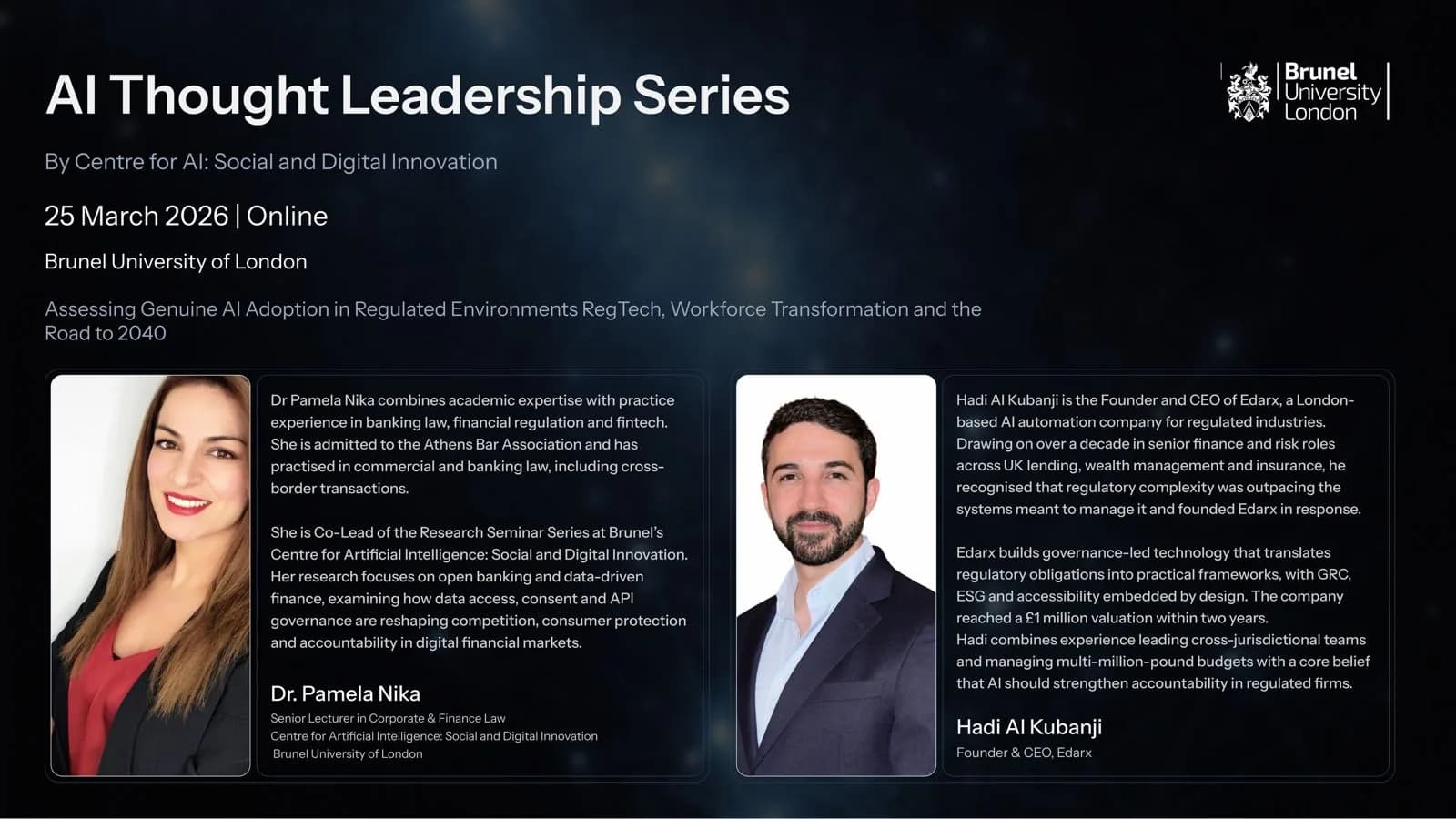
During the AI Thought Leadership Series at Brunel University London's Centre for AI: Social and Digital Innovation, Edarx Limited explored a major challenge facing regulated industries: while the use of artificial intelligence (AI) is growing rapidly, the systems and rules (governance and RegTech) that should oversee it are not advancing as fast.
AI is no longer just being introduced by company leaders from the top down. Instead, employees are bringing AI tools into their daily work routines on their own. This often happens without formal monitoring or approval, a phenomenon known as "shadow AI".
This way of adopting AI from the bottom up puts pressure on organisations. Companies now have to deal with technologies they did not officially roll out, and they often lack the proper controls to manage these new tools safely and effectively.
Meanwhile, the general conversation about AI is heavily influenced by excitement and exaggerated claims. Many companies are claiming to be more advanced in their use of AI than they really are. This can lead to "AI washing", where the suggested abilities of AI within a business are much greater than what is actually in place and properly governed.
The issue is likely to become even more serious as we approach 2040. Millennials, Generation Z and Generation Alpha will form the majority of the workforce. These groups have grown up with technology and expect workplaces to use AI naturally, even when many organisations are still dependent on older (legacy) systems.
The outcome is a growing gap between what companies can do with AI, how advanced they claim to be, and how much real control they have over these technologies.
Edarx Limited emphasised that RegTech (technology designed to help meet regulatory requirements) should serve as the main control layer. RegTech can provide essential functions like monitoring, auditing, and enforcing policies, helping to make sure that how AI is actually used matches up with what regulators expect.
The main takeaway was clear: as we move towards 2040, organisations will not stand out by how quickly they adopt AI, but by how well they manage and control it, and by how honestly they communicate their true capabilities.
Want to talk about this work? Drop us a line.